IFS Chatbot · Parts Work Support
Looking for an IFS chatbot?
Most AI therapy chatbots are built around generic emotional support or CBT-style prompts. Unblend is different: an IFS-informed mental wellness app for the moments between therapy sessions, designed to help you notice Parts, unblend from triggers, and bring clearer material back to your therapist.
Use voice or text to check in, surface recurring protectors, and review Parts Cards from real conversations in a HIPAA-compliant environment when used with your therapist.
Not a replacement for therapy · If you are in crisis, call 988 (US)
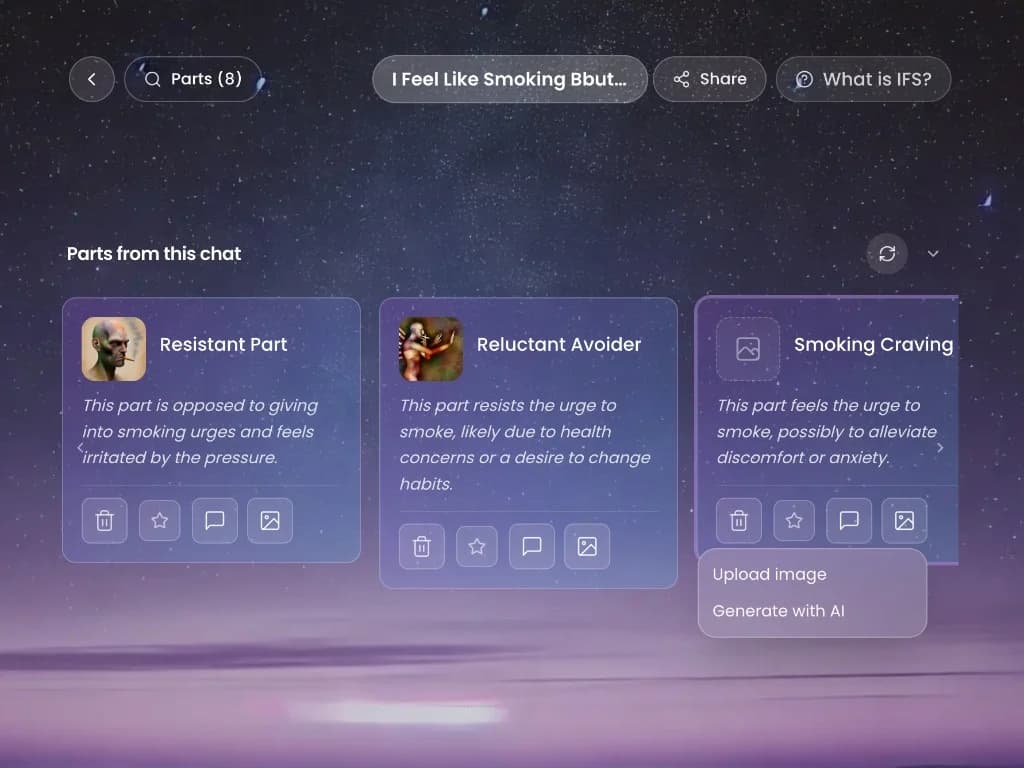
Real Parts Cards from chat
Actual product UI showing how conversations surface named parts and patterns.
What people usually mean by “IFS chatbot”
When someone searches for an IFS chatbot, they usually are not looking for a generic AI companion. They are looking for a tool that can speak the language of Parts, help them notice when they're blended, and support the actual work they are doing in Internal Family Systems therapy.
In other words, they want a chatbot that understands that one part may be trying to control, another may be avoiding, and another may be carrying pain. They want something closer to parts work support than to a generic “how does that make you feel?” bot.
That is exactly the gap Unblend is built for: the days and moments between sessions, when a Part gets activated and you need a place to slow down, reflect, and return to Self-energy. If that active moment is what you are trying to navigate, start with how to unblend and then come back here for the product-specific version.
What makes an IFS chatbot actually useful
It recognizes Parts, not just moods
A useful IFS chatbot helps you distinguish protectors, urges, critics, avoiders, and wounded parts instead of flattening everything into “stress” or “negative thoughts.”
It supports unblending
The goal is not to argue with a Part. It is to help you slow down, create space, and come back to curiosity and Self-leadership.
It works by voice and text
Some Parts show up best in writing. Others come out when you speak. Unblend supports both, which makes it easier to work the way your system actually works.
It leaves a reviewable trail
Real progress happens when you can see recurring Parts and themes over time. Parts Cards and a Signal Report make the work reviewable instead of ephemeral.
Unblend vs a general AI therapy chatbot
General AI therapy chatbots often optimize for broad accessibility. They give calm, supportive, often useful responses — but they are usually not specific to Internal Family Systems.
They may help with journaling, reframing, or tracking mood. But if you are in IFS therapy, what you need is often more specific: “Which Part showed up?”, “What is it protecting?”, “Can I get enough space from it to listen rather than react?”
Unblend is built around that exact use case. It is not trying to be every kind of therapy chatbot. It is trying to be the right between-session tool for people doing parts work and for therapists who want clearer continuity between sessions.
If you want the broader product overview, see our full IFS therapy app guide. If you want the theory behind blending itself, start with What is being blended?. If privacy is the deciding factor, read our HIPAA and IFS security write-up.
Privacy, terms, and crisis boundaries
Unblend is not an emergency service. If you are in crisis, call 988 (US) or your local emergency number. For PHI, BAAs, and how therapist practices use the platform, use the links below.
Related reading
IFS therapy app
The full between-session overview: product, safety, comparison, and FAQs.
Best AI therapy apps (IFS)
A modality-fit comparison—why generic CBT chatbots differ from Parts-forward tools.
What is being blended?
Understand what it means when a Part takes over your system.
How to unblend
A step-by-step guide for returning to Self in moments of activation.
Returning to IFS therapy
After a break or pause—how to re-enter parts work with pacing and honesty.
HIPAA & IFS
How Unblend protects PHI, Parts Maps, and therapy-adjacent conversation data.
AI vs human therapy
Why a useful mental health AI should extend therapy, not pretend to replace it.
Will AI replace therapists?
A research-style answer on IFS depth work, governance, and where tools belong.
For therapists
See how clinicians use Unblend to support parts work between sessions with clients.
Frequently asked questions
Is there really an IFS chatbot?
There are many AI therapy chatbots, but very few are actually designed around Internal Family Systems. Most default to CBT-style reframing or generic emotional support. Unblend is built specifically for parts work between sessions, using IFS-informed prompts, voice and text conversations, and a reviewable Parts Cards interface.
Can an IFS chatbot replace an IFS therapist?
No. An IFS chatbot should support reflection, practice, and between-session continuity — not replace therapy. Complex trauma, unburdening work, and deep protector-exile dynamics still belong with a qualified clinician. Unblend is designed to complement IFS therapy, not substitute for it.
How is an IFS chatbot different from a general AI therapy chatbot?
A general AI therapy chatbot often uses broad emotional support or CBT-style thought reframing. An IFS chatbot should help you notice Parts, unblend from them, build Self-energy, and track recurring protectors or patterns over time. That is the difference Unblend is designed around.
Does Unblend work by voice or text?
Both. You can check in with Unblend using voice or text. That matters for IFS work because some Parts are easier to access through spoken reflection, while others emerge more clearly in writing.
Is Unblend private enough for therapy-adjacent use?
Yes. Unblend is built as a HIPAA-compliant platform. When used as part of a therapist's practice, data can be covered by a signed BAA. Read more at /ai-mental-health/hipaa-ifs-security.