Overview
Unblending is the active practice of recognizing that you are not your emotional reaction. It's about pausing, breathing, and using curiosity and compassion to connect with the Part that has taken over—and ultimately regaining leadership of your inner system.
In our previous article, we explored what blending is: the moment when a Part takes over your system, and your centered Self temporarily steps aside. Now comes the most empowering step: Unblending.
Unblending is the active practice that restores choice. It’s the journey back to your core Self, allowing you to see your Parts with clarity and lead your life with compassion.
What Does "Unblending" Actually Mean?
Unblending is simply the process of creating space between your core Self and the activated Part. It’s not about pushing the Part away; it’s about stepping out of its emotional intensity so you can observe it.
When you unblend, you shift from being the Part (e.g., 'I am angry') to being with the Part (e.g., 'I notice a Part of me is feeling intense anger'). This shift is where all freedom begins.
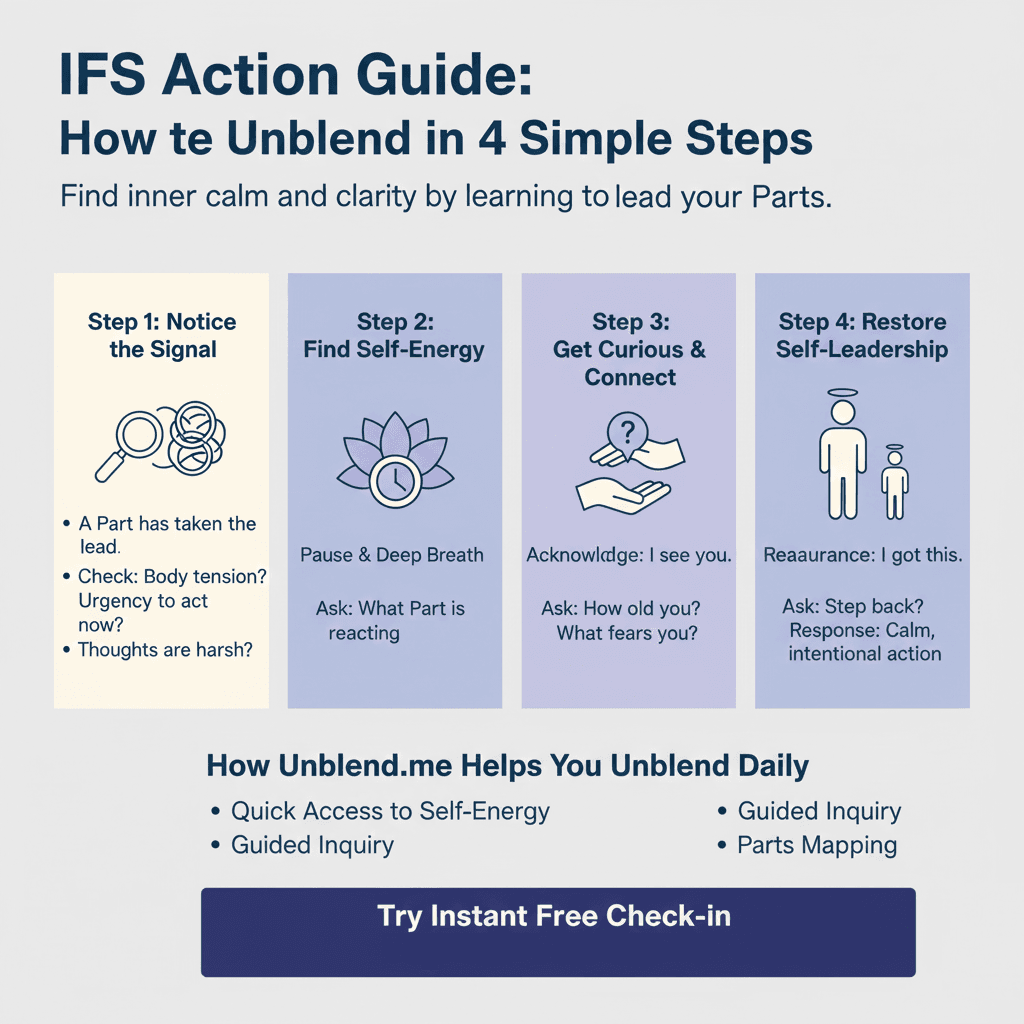
The 4-Step Guide to Unblending
Unblending is a practice, not a destination. You can apply these four steps anytime you feel hijacked, reactive, or overwhelmed.
Step 1: Notice the Signal (Catch the Blend)
The first step is always Awareness. You can't unblend until you realize you're blended.
- Check the Body: Do you feel tension, a racing heart, or shallow breathing?
- Check the Urgency: Do you feel an intense urge to act (to snap, to eat, to numb, to flee)?
- Check the Narrative: Are your thoughts suddenly harsh, black-and-white, or judgmental?
If the answer is yes, simply say to yourself: "A Part has taken the lead right now." This simple recognition is half the battle.
Step 2: Find Self-Energy (The Pause Button)
To access Self-energy, you need to create space from the intensity of the Part. This means moving from the Part's energy (fear, urgency) to the Self's energy (calm, curiosity).
- Physically Pause: Stop what you are doing. Don't speak, don't text, don't scroll.
- Breathe: Take 3-5 deep, slow breaths. Ground yourself by feeling your feet on the floor.
- Check In: Ask yourself, "What Part of me is reacting right now?" Do not judge the answer.
By pausing, you tell the Part: I see you, but I am in charge of the response.
Step 3: Get Curious and Connect
Once you are grounded in Self-energy, you can approach the Part with the curiosity and compassion it deserves. This is the heart of IFS work.
- Acknowledge: Say to the Part, "I see you, and I know you are trying to help me right now."
- Get Curious: Gently ask the Part two key questions:
- "What are you afraid will happen if you don't do this job?"
- "How old do you feel right now?"
Remember, protective Parts fear letting go of control. Listening to their fear is what allows them to trust you.
Step 4: Restore Self-Leadership
This final step is the renegotiation with the Part. It assures the Part that it can step back because the adult Self is capable of leading.
- Offer Reassurance: Tell the Part, "Thank you for protecting me. I am here now, and I can take the lead."
- Ask Permission: Ask the Part, "Would you be willing to relax and step back a little so I can handle this?"
- Take Action: From a place of calm, choose an intentional, Self-led response (instead of the Part's impulsive reaction).
You don't need the Part's total surrender—just enough space to act from a centered place.
Protectors in relationships
Many people notice blending most sharply around other people: criticism from a partner, feeling unseen by a friend, or tension with family. A protector may jump in to control, please, withdraw, or attack—often faster than you can think.
When that happens, the same four steps still apply, with one relational tweak: pause before you send the text, make the face, or walk out. Name the Part (“a defender is forward”) and buy sixty seconds of breath. You are not fixing the relationship in that minute—you are restoring enough Self-energy to choose your next move.
Between appointments, a short voice or text check-in can help you notice when a Part is active while the moment is still fresh. See our IFS therapy app overview or the IFS chatbot page for IFS-specific between-session support—not generic advice shaped like CBT homework.
How Unblend.me Facilitates Unblending in Real-Time
Unblending sounds simple, but practicing it during daily stress is hard. That's why Unblend.me is designed to be your instant guide — see our IFS therapy app overview for the full tour, explore the IFS chatbot page for the product-intent version, or, if you're still unclear on what blending means, start there first:
- Quick Access to Self-Energy: Our platform is literally a pause button. Just open the app and the calm begins.
- Guided Inquiry: UB (our companion) provides the exact gentle, non-judgmental questions from Step 3 when you need them most.
- Parts Mapping: The system helps you track the history and motivations of your Parts, making Step 1 (Notice) much easier over time.
Unblending is the opposite of reacting. It is the conscious choice to pause and lead with your highest qualities.
Unblending is a Practice, Not a Performance
You will always blend sometimes—that is human nature. The success of unblending is not measured by perfection, but by how quickly you can return to Self-leadership.
If you can reduce the time you spend blended from 30 minutes to 5 minutes, you are winning. If you can move from yelling to pausing and breathing, you are winning.
Start practicing these four steps today. You don't have to carry your Parts' burdens alone anymore.
FAQ
I took a break from IFS or therapy—where do I start?
You are not starting from zero. Re-read what blending means, practice Step 1 (notice the signal) on small moments, and bring one real example to your next session. For a longer guide, see returning to IFS therapy. If you want support between therapy sessions while you rebuild rhythm, explore the IFS therapy app—it complements clinical care; it does not replace it.
How long does unblending take?
Some shifts happen in minutes; deeper protector trust can unfold over months or years with a clinician. Unblending is a skill you repeat—not a one-time fix. Unblend’s role is between-session scaffolding: help you catch blending sooner, name the Part, and carry clearer patterns into human therapy. It is not crisis care, diagnosis, or a substitute for licensed treatment. In the U.S., call or text 988 if you are in crisis.
Can Unblend replace my therapist?
No. Unblend is IFS-informed mental wellness support for the hours between sessions—reflection, Parts language, and continuity. Treatment decisions, risk assessment, and trauma processing belong with a qualified human therapist.
What if fixation or longing takes over?
Many people describe romantic obsession or limerence as a Part trying to protect against rejection or abandonment. That framing can reduce shame and increase curiosity—see also what is being blended. If you feel unsafe or unable to function, seek professional support; this article is educational only.
Where does DBT fit if I also use skills?
Some people combine parts work with skills-based models. For a neutral comparison of when each frame helps, read DBT vs IFS—then return here to practice unblending steps in the moment.
Model lineage and further reading
These steps condense common IFS practice patterns taught in Level 1+ trainings via the IFS Institute. They are educational—not individualized clinical instructions.
References
- IFS Institute — training pathways
- Unblend — What is being blended?
- Haddock et al. — pilot randomized trial of IFS for depression (2017)