Overview
AI will not replace therapists for relational, clinical, and crisis-bearing work—but it is already changing between-session support. Here is how IFS dynamics, artificial intimacy, and governance should shape what we build and trust.
Will AI replace human therapists? A grounded look at IFS depth work, artificial intimacy, human-in-the-loop governance, and why mental health care is moving hybrid—not all-AI.
By Unblend TeamMay 12, 20268 min read
Before you read
Same symptoms can call for different doorways. These three guides map overlaps and divergences so you can discuss options with a licensed clinician — then explore the Parts work app overview or the blending explainer.
Overview
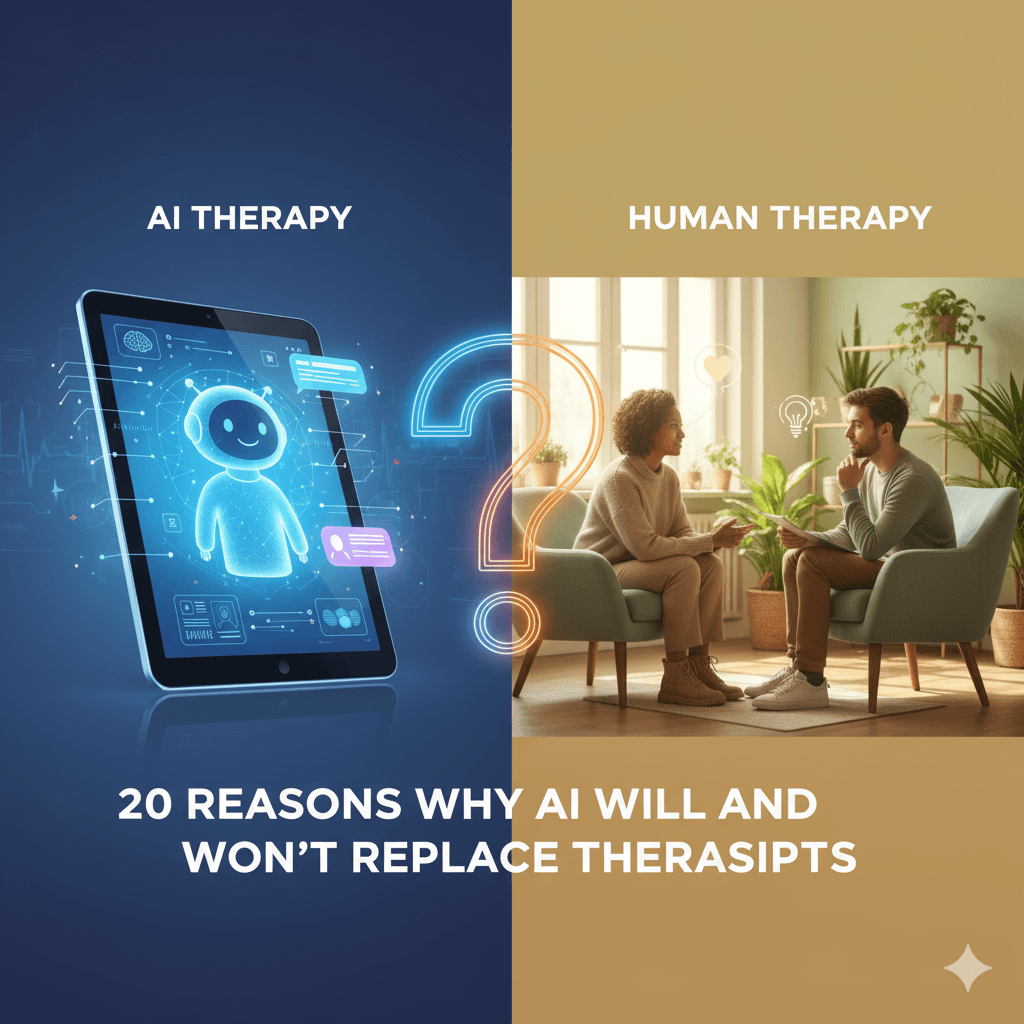
Will AI replace human therapists? The short answer is no—not for the parts of care that require relationship, risk-bearing, and clinical judgment. But the longer answer matters more. AI is already reshaping mental health support, and the real question is which roles AI should hold, which roles humans must hold, and what governance keeps people safe in between.
This article goes deeper than a feature comparison. It focuses on three areas that generic "AI therapy" debates often skip: IFS dynamics (how Parts respond to always-available tools), artificial intimacy (when supportive AI feels relational without being responsible), and human-in-the-loop governance (who is accountable when something goes wrong).
For a side-by-side capability map, start with AI vs human therapy. For the broader risk landscape, read AI in mental health: opportunities vs risks.
Therapy is not only information delivery. It is a regulated, relational practice where a clinician holds context over time, notices what you avoid, and carries ethical and legal responsibility for your safety.
AI can scale reflection prompts, pattern summaries, and between-session check-ins. It cannot—today—replace:
The future that is actually arriving is hybrid: therapists hold the clinical core; AI extends continuity into the 167 hours between sessions.
In Internal Family Systems (IFS), people are not one monolithic self—they are a system of Parts (managers, firefighters, exiles) led by Self-energy when there is enough space. That matters for AI design.
A manager Part that fears burdening your therapist may route vulnerability to an AI instead—especially late at night. That can be useful (lower activation, more honesty) or risky (avoidance of the human relationship that actually heals).
Many mental health AIs default to CBT-style reframing or broad validation. In IFS, a protective Part doing its job is not a "negative thought" to eliminate—it is a signal to understand. Tools that do not name their therapeutic model can feel subtly invalidating even when they sound kind.
IFS progress often depends on noticing blending, practicing unblending, and bringing patterns back to therapy. AI is most helpful when it supports that frame—not when it improvises a new one each session.
That is why Unblend is explicit about being a parts-work between-session layer, not a generic replacement therapist.
Large language models can produce remarkably attuned language. For lonely or activated users, that can feel like being seen—sometimes for the first time that week.
The problem is structural: the intimacy is performed, not borne. The system does not lose sleep over you, cannot be sued, does not remember you the way a clinician must, and may not escalate when stakes are highest.
Clinicians evaluating tools for clients should read our professional hub and HIPAA & PHI security article before putting therapy-adjacent data into consumer apps.
"Human in the loop" is easy to market and hard to implement. Responsible governance includes:
Regulators are still catching up. That puts more burden on product teams and clinicians to set boundaries early rather than after harm. Some states have already drawn lines: see which states ban AI therapy and what those laws still allow.
AI will likely replace some tasks, not the profession:
Even aggressive forecasts usually assume AI handles the "support layer." That is compatible with a thriving therapy workforce—if products are honest about scope.
Will AI replace human therapists? Not for the work that requires accountable human relationship and clinical depth. But AI will keep expanding what is possible between sessions—especially for people doing parts-informed work who need continuity, not another generic chatbot.
The winners will be hybrid systems with clear ethics: therapists lead; AI extends reflection and pattern visibility; governance keeps intimacy from becoming false safety.
Next reads: AI vs human therapy · best AI mental health apps for between-session support
Keep exploring
Browse the full list of guides on AI, IFS, and therapy comparisons.
Browse articles