Overview
DBT and IFS both help people who feel emotionally flooded, reactive, or stuck in painful patterns. But they do it in very different ways: DBT teaches regulation skills directly, while IFS works with the inner parts driving those reactions.
DBT vs IFS: learn how Dialectical Behavior Therapy and Internal Family Systems differ, where each shines, and when a parts-work approach may fit better than skills-first treatment.
By Unblend TeamJune 1, 20268 min read
Before you read
Same symptoms can call for different doorways. These three guides map overlaps and divergences so you can discuss options with a licensed clinician — then explore the Parts work app overview or the blending explainer.
Overview
DBT and IFS are often recommended to people who feel emotionally overwhelmed, reactive, or locked in painful cycles. At first glance they can look similar because both help people slow down and respond differently. But under the surface they come from very different assumptions about what healing requires.
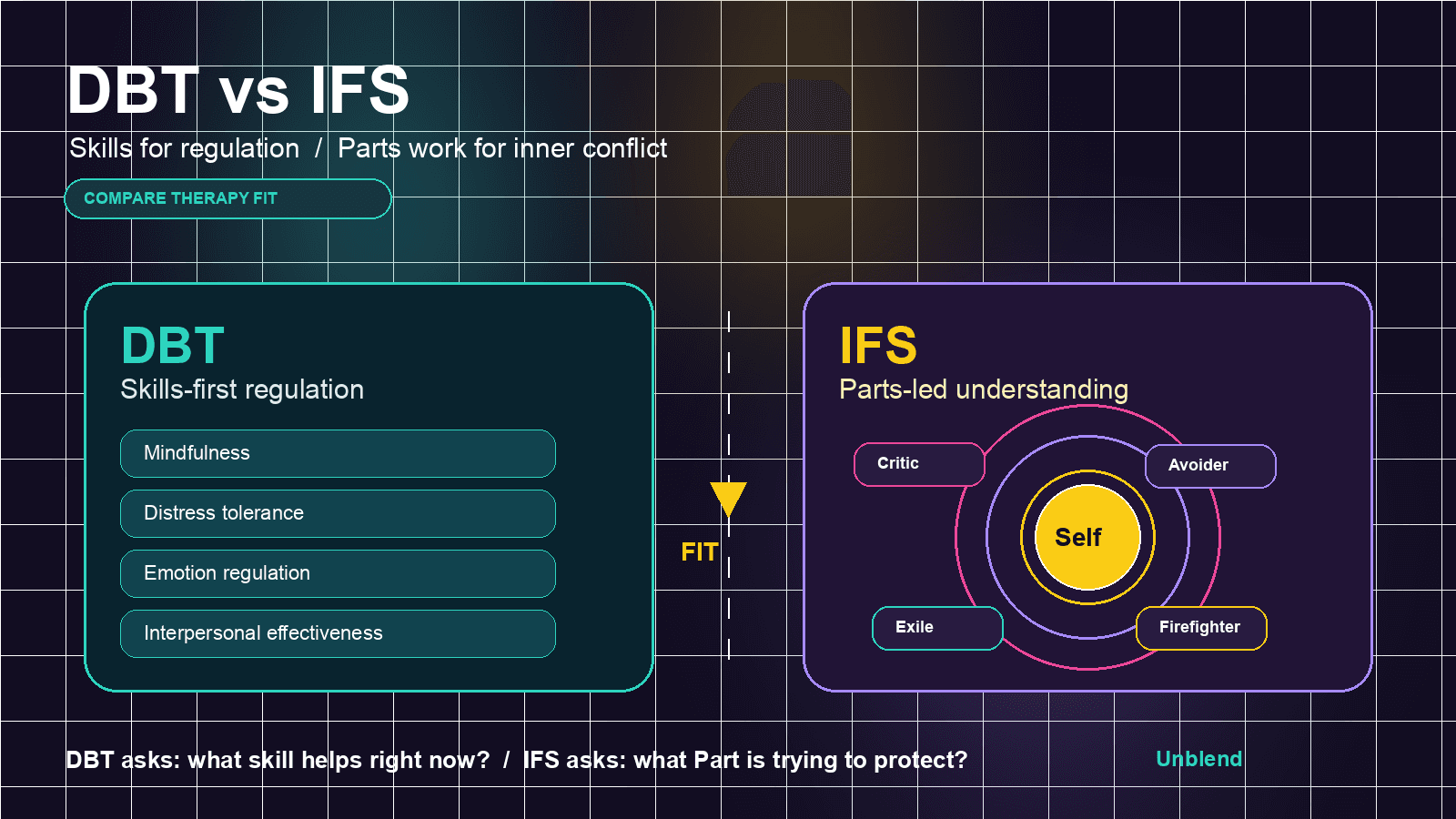
Dialectical Behavior Therapy (DBT) was developed by Marsha Linehan. It combines behavioral psychology with mindfulness and is best known for teaching concrete skills in four areas: mindfulness, distress tolerance, emotion regulation, and interpersonal effectiveness.
DBT is especially useful when you need tools that work right now. If emotions are moving too fast, or if self-destructive patterns keep taking over, DBT gives you structure and repeatable practices.
Internal Family Systems (IFS) is a parts-based therapy model. It assumes your mind contains different Parts — protectors, exiles, managers, firefighters — and that symptoms often make more sense when you understand which Part is trying to help. The work is not just to control reactions, but to build relationship with the Part underneath them. If you are new to the model, start with what blending is and how to unblend.
DBT asks: What skill helps you survive and respond better in this moment?
IFS asks: What Part is taking over right now, and what is it trying to protect?
That difference matters. DBT is often a better fit when the first need is stabilization. IFS is often a better fit when the deeper question is internal conflict, shame, self-criticism, or recurring protectors that keep showing up even after you know the right skill.
This is a common real-life stress test. A critical email, a partner's tone, or conflict in a group chat can activate your nervous system in seconds.
DBT-style move: use an immediate regulation skill (pause, temperature, paced breath, grounding) to reduce intensity so you do not escalate the situation.
IFS-style move: identify which Part got activated (defender, people-pleaser, withdrawer, inner critic), then unblend enough to respond from Self rather than from urgency.
In practice, many people do both: stabilize first, then get curious about the Part. If you want an in-the-moment framework, use how to unblend. For body-led regulation overlap, see somatic therapy vs IFS.
This article is informational, not medical advice. If you are in acute crisis, call or text 988 (U.S.) or local emergency services.
Yes. Many people use DBT skills to get enough stability and then do deeper parts work with IFS. In practice, DBT can help you stop the spiral, while IFS helps you understand why the spiral keeps happening.
Unblend is not a DBT app with an IFS label on it. It is designed for the moments between therapy sessions when an activated Part is present and you need help slowing down, reflecting, and returning to Self-energy. That makes it naturally aligned with IFS, though people doing DBT-informed work may still find the between-session reflection helpful as support between therapy sessions. See our parts work app guide for the full product overview.
DBT has strong randomized-trial support—especially for borderline personality disorder and emotion dysregulation—built on Marsha Linehan’s protocol work. IFS evidence is newer and structured differently (parts, Self-energy), so “which is more researched?” usually favors DBT at the level of trial volume—without implying universal superiority. Many clinicians blend stabilization skills with parts work when ethics and pacing allow.
DBT is often strongest when you need reliable regulation skills fast. IFS is often strongest when you need to understand and relate to the parts underneath the reaction. Neither is universally better. The question is whether your next best step is more skill, more understanding, or both.
Weighing more than one option? See CBT vs IFS, EMDR vs IFS, Somatic therapy vs IFS.
Keep exploring
Browse the full list of guides on AI, IFS, and therapy comparisons.
Browse articles